Sunday, August 19, 2012

April-August Roll-Up

Before it gets even more embarrassingly tardy, I need to update our activities over the last five months. First, no cruising with the exception of a 5-day jaunt to Anacortes in May to attend Trawlerfest.  Our big activity has been to first get our house ready to sale (April through June) and then (since June 30) keep it looking good while it has been on the market.

At the end of April we started subletting slips at Shilshole Marina and move on board Alpenglow. That got us out of the way of the contractor while work was done on the house and spared the cats the trauma of being confined to a small area while scary noises happened around them. Now that the house is on the market, remaining on the boat keeps the house cleaner and eases the showing of the house by the realtor.  It does mean we commute regularly from Shilshole in the Ballard neighborhood to the house in West Seattle.

2012-08-010-013Living in Shilshole has been fine. It is a big marina (3,000 slips) but since a maximum of 300 slips are for live-aboards, except for weekends and sunny weekday evenings, it is pretty quiet.

Ballard has a strong Scandinavian heritage (especially Norwegian) and a statue of Leif Ericson stands prominently on marina grounds, staring to the northwest and keeping watch over the moored vessels.

Our sublet at Shilshole runs through the end of August. Hopefully we’ll do a little cruising before settling back in for the winter at our yacht club’s Winslow station.

Wednesday, March 28, 2012

A Change in Scenery

Up until recently, we have been wintering the boat (i.e., the September through May we aren’t cruising) on Lake Union. That site was convenient from our house, an 8 or 9 mile drive, but noisy and dirty (it was almost directly underneath the I-5 bridge crossing the Lake Washington Ship Canal).

In early February we were fortunate enough to be offered a winter moorage slip at our yacht club’s (QCYC) outstation docks in Winslow on Bainbridge Island. The winter moorage is available from mid-September to mid-May which accords perfectly with our planned cruising schedule. Additionally, the outstation is everything the Lake Union site wasn’t (i.e., clean, quiet and secure). While it isn’t as convenient to our house as the Lake Union site, once we are living on the boat, that isn’t an issue.

Below is a photo from the stern of the boat of our new neighbors.

Our current plans are to remain here until the end of April at which time we will move to a slip in Shilshole Marina on the Seattle side of Puget Sound we are subleasing through August. This will give us the convenience of living on the boat (not really an option at the Lake Union site) with good access to our home as we prepare and list it for sale.

Thursday, March 1, 2012

Keeping Cool

The additional monitoring sensors I installed in our NMEA2000 system this winter has provided a wealth of data. One tidbit was the temperature of the two AC transformers (isolation and step-down) in our electrical system. I was surprised at the the increased temperature above the ambient engine room temperature in the transformers as I was pulling power through them to operate the two electric heaters.

At our moorage we are on a 30A/120 volt circuit. Normally, we don’t pull more than 15 to 20 amps on a steady basis. This gives a little headroom in case there are transient loads from the DC charger pulling power to service the DC side of the boat. With that steady state load, I’d routinely see a 15 to 20 degree increase above ambient in the transformers. While probably not a big issue, heat tends to accelerate the degradation of components so I thought I’d see what I could do.

The transformers are toroidal style (i.e., doughnut shape) which means there is a hole through which I can pull cooling air. I wanted the fans to only operate when the tranformers were working so I tapped into the AC power being put into the transformers. After the installation of the fans, the transformers are running about 10 degrees cooler, in the 5 to 10 degrees above ambient engine room temperature.

Saturday, February 4, 2012

Keeping Track of Things

The largest project on the boat this winter has been to take advantage of the NMEA2000 backbone running through our boat and increase the level of system monitoring that we do.

When Seahorse Marine built our boat a couple of years ago, we had them install many components that operated using the marine industry standard NMEA2000. The big advantage of this system is that data and power for the components all run in one backbone cable. When you want to add a module you insert “T” junction that taps into the backbone and pulls data and power off on to a drop line to the new module. So long as you comply with some relatively straightforward restrictions on cable lengths it is pretty idiot proof.  Once a module is on the backbone and some minor configuration completed, its data is available in the display modules elsewhere in the boat.

Up until now, the modules installed were mostly oriented towards navigation (e.g., GPS, compass, wind, depth). This winter we’ve added a DC module, an AC module and a temperature module. While there are a number of vendors of NMEA2000 equipment, the most complete product line is from Maretron, a company based in Phoenix and who manufactures in Bend, Oregon (neither location coming to mind when thinking of marine electronics).

The DC module (DCM100) measures voltage, current and temperature. I installed the voltage and current sensors to measure the output from the DC charging system (either the alternator or the inverter/charger). The temperature being measured is the house bank battery.

The AC module (ACM100) measures voltage and current. I installed its sensors at the output from the AC source selector switch. There are analog meters at the electrical panel that do the same thing but 1) I have to make the effort to look at them and 2) the sensitivity of the meters is pretty coarse.
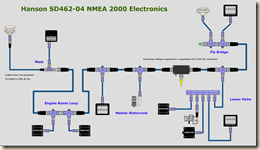
SD46204 - NMEA 2000The temperature module (TMP100) will accept 4 temperature sensors that operate from -50° F to 176° F. I am measuring 1) the air temperature inside the isolation transformer box; 2) the air temperature inside the 240VAC/120VAC step down transformer box; 3) engine room air temperature; and 4) the house battery bank alternator temperature.

I installed a probe on the engine start battery alternator but did not attach it to the TMP100 since I ran out of inputs. Depending on what temperatures I think are important to monitor, I could add it to the mix by swapping something else out.

Now that I can gather all of this additional data, I’ll have to give it some time while I build up a baseline to know when things are operating normally and when something is not right as reflected by values (e.g., temperatures) outside the norm.

Sunday, January 29, 2012

The Price of Ice

Last summer while visiting Tracy Arm with our friends the Crowders, we did a tour down to the snout of the North Sawyer Glacier (Crowder visit).

As we were viewing the glacier a nice chunk fell off. We were about a half mile away so I wasn’t worried about the wave but I maneuvered the boat (we had been in neutral just bobbing along) so as to take the wave on the bow. At the time there were “growlers” (see ice sizes) in the water nearby. As the splash waves passed underneath the boat, we began to “hobby horse” a bit. Unfortunately during one of the cycles, some ice was underneath the bow area. We heard the thump but had no concern about damaging our steel hull.

That evening, as we entering the anchorage for the night, I turned on our forward looking sonar (FLS). Unlike a downward facing depth sounder, the FLS is oriented forward and can give you a heads up about what is in front of you (how it works). The FLS display screen simply showed a line at a 45 degree down slope. Having anchored in the same spot the day before I knew that wasn’t correct. Since the FLS worked fine up until then, I feared that it might have been damaged during the ice “thumping.”

Flash forward six months to the middle of January, we had a diver inspect our bottom paint and zincs for wear. We also had him inspect the FLS transducer. Sure enough, the transducer shows its impact with the ice.

Although the transducer is, in theory, replaceable while the boat is in the water, we’ve decided its replacement can wait until we have the boat hauled at some point in the future as part of bottom maintenance or other work. In the meantime, I’ll be more careful around ice.

Monday, September 26, 2011

2011 Anchorages and Moorages

Below is a map of all of our stops we made along the way this year. 
(The blue marks for the stops may not show up in Internet Explorer, try another browser like Firefox or Chrome)


View 2011 Alaska Cruise in a larger map

Thursday, September 22, 2011

September 17-20 – The Finish Line

To close out our 2011 cruise on the morning of September 17 we headed south down Rosario Strait, along the west shore of Whidbey Island and into Admiralty Inlet. There is lots of commercial traffic in that area, so you venture into the vessel traffic lanes with a keen eye on the AIS in order to make sure you aren’t going to run over by a freighter moving at 20 knots. We will able to successfully cross without any major issue.

On account of the timing of the currents and the shorter days, we knew we needed an intermediate stop for the night between Anacortes and Winslow (Bainbridge Island). We decided to try the inner harbor in Port Ludlow. While the entrance is a bit shallow (~15 feet), it was short and straight with no current. Additionally, it was very protected from winds, a important consideration given the forecasted high winds for the next day. To top it off, the anchorage was remarkably scenic. While there were many homes along the shore, they were landscaped nicely and not closely packed.

The next morning, September 18, we elected to take a rest day and not move. The weather wasn’t terrible but docking with significant winds (15-25 kts) is not my favorite thing. The winds the next day were forecasted as light.

The early start on September 19 put us at the Queen City Yacht Club docks in Winslow before noon. We used the afternoon to start the boat cleaning process. Marcia working the interior while I tackled the exterior.

On September 20, the weather remained lovely for the final miles across Puget Sound, through the Ballard Locks and along the Lake Washington Ship Canal to our winter moorage in Lake Union. When transiting the locks we do our best to select a less busy day and time and calm winds. With just the two of us on board, we want to stack the odds in favor of an uneventful “lock-thru” and everything went smoothly. The time from Winslow to Lake Union, three draw bridges that had to open and one lock-thru was less than three hours.

The distance on this leg was 85.7 miles bringing the total trip distance to 3465.3 nautical miles. Total engine hours were 577.4 which works out to 6 miles per hour of engine time. Our actual speed is a bit faster since the engine hours include the time from when we weigh anchor or unmoor at the beginning of the day to the time when we are secured at anchor or dock at the end.

Saturday, September 17, 2011

September 13-16 – Home Stretch

The winds that blew us onto the dock in Ganges quieted down overnight and our departure on the morning of September 13 was very uneventful. We motored down Saanich Inlet and entered the calm protected waters of Tod Inlet.

2011-Cruise-990xAfter lunch we paddled our kayaks the 200 yards to shore and walked 10 minutes to the Butchart Gardens. The amount of work and care that goes into providing blossoming and colorful plants the year round is 2011-Cruise-988ximpressive.

As we paddled back to the boat from shore, another kayak was paddling along the shore. As he got closer, he asked whether I was “Kurt Hanson.” I was a bit taken back but he introduced himself as Brian McCutcheon a friend of John Douglas owner of Laysan, a sister ship to ours. John is preparing to bring his boat back from Subic Bay in the Philippines to Hawaii where John lives. He asked Brian to intercept us in Tod Inlet and find out how things have been working in the long term on our boat.

It was a great visit and we wish John a safe and speedy journey across the Pacific.

The next morning, September 14, we headed across Haro Strait and reentered US waters. We’ve signed up through the NEXUS program with the Customs and Border Patrol and were able to clear over the telephone. We proceeded directly to Echo Bay on Sucia Island where we dropped the anchor.

The entire island is a Washington State Park and it has some very pleasant trails to walk. We elected to spend two nights so that we could cover them all.

An early start the morning of September 16 got us to the fuel dock in Anacortes at 10:30 AM. The only fuel we had taken on since last September was 200 gallons in Juneau. We weren’t surprised it took 1090 gallons to fill all our tanks. The 1290 gallons since last year has cover 580 engine hours, 30 genset hours and lots of furnace operation. We were in our assigned slip in Cap Sante Marina by noon.

From here we will head south to Seattle. We will probably swing by our yacht club’s (Queen City YC) outstation in Winslow for a night or two prior to transiting the locks into Lake Union. Hopefully home next Tuesday, 9/20.

Distance covered this leg is 83.3 for a total of 3379.6 nautical miles.