Tuesday, October 20, 2009

Progress being made

Marcia and I speak daily using Skype. It generally works well but the limiting factor is the connection speed at Marcia’s end.  If she tries to do other things on her computer that use Internet bandwidth or if other people with whom the connection is shared use too much capacity the quality suffers. The delay is a bit like a phone call routed through a satellite and you have to be conscious of not “stepping on” the others comments.

Over the weekend (October 17-18), she was going through the boat with our surveyor, Ray Wolfe. He prepared a list of findings and the yard is now working through them.  Marcia provides the necessary clarification/feedback to ensure that they are properly addressing the findings.

On Tuesday Marcia met with our project manager and the production staff and they worked out the following schedule:

 
  • Finish survey finding this week (except for carpentry many of these things are already done).
  • Finish carpentry work end of next week (10/25-31)
  • Cushions covered by end of next week
  • Apply non-skid next week
  • SHM testing now to final inspection; Hanson’s poke around to familiarize with vessel
  • Final inspection the first week of November
  • Move in after final inspection
  • Correct deficiencies, testing and sea trials 2nd week November through shipping
  • Ship vessel mid December to early January

Saturday, October 10, 2009

New Technology (aka “Toy”)

FlipUltraHDWe just purchased a Flip Ultra HD video camera (Flip).  The camera is a little large than a pack of cards, very light and records HD video (1280 x 720).  The video is highly compressed so the image quality is modest but acceptable given its convenience and low cost.

We expect to use the camera to help our documenting Alpenglow while in China.  We can imagine that people will be doing massive “data dumps” of information on us, so rather than writing sketchy paper notes of what people are telling us, we thought we would try video recording the briefings.  In addition, the camera is small enough that sticking it into a tight location while recording and panning about may give us some images we will find useful in the future.

Below is a YouTube video I uploaded from clips I took on a hike up to Cutthroat Pass last Thursday, October 8.  Depending on available bandwidth, I may try a few video reports while in China.

Friday, October 2, 2009

Roll Stabilization

An unavoidable consequence of a boat floating on a surface of water that has waves is the boat will roll (rotate right or left around the long axis of the boat).  As the waves become bigger, the rolling is usually greater and faster.

Sail boats have an advantage over power boats in these conditions because the force of the wind on the sails usually dampens or stops the rolling motion of the boat.  Power boats without sails have to use other means if they want to dampen rolling.

The stabilization methods are typically broken down into “active” and “passive”.  Active means an active control unit sensing motion and dynamically controlling some mechanism. Passive is the absence of a control unit but relies on a feedback mechanism inherent to the stabilizing device.

The most common active stabilizing method is a fin stabilizer. In effect, a stubby wing sticks out from the side of the boat and pitches up or down to create compensating forces to the roll of the boat (Naiad Stabilizer). Most require a hydraulic pump on the main engine which goes to the fin actuators and a control unit to sense in real-time the boat’s motion and direct the actuators.

While we have saved space in the engine room for an active stabilizer installation, we are starting with a passive stabilizing method, paravanes.

Kohlstrand Patent

The diagrams to the left and below are from a US patent for the “fish” hanging on chain at the end of the paravane poles. The short description is that “fish” on the downward rolling side plunges while the fish on the upward rolling side resists the motion. This action tends to dampen the rolling motion of the boat.

Kohlstrand Fish

Our friends Dorothy and Dave Nagle, owners of the Seahorse Marine Diesel Duck David Ellis (David Ellis blog), encountered a fisherman in Juneau who raved about some fish made by a marine supply store catering to fisherman in Astoria.  Marcia called the store and found out that they are made by a 90+ year old gentleman in Westport. At that point, we decided now was the time to buy them.  To the left is a photo of Marcia in Westport with her newly captured fish.

The Westport fish are slightly different than Kohlstrand fish (the type shown in the patent drawings above). The wings are marine plywood and the lead nose is a hemisphere of  lead bolted through the wing.

Thursday, October 1, 2009

Final Stretch

We are coming down to the final stretch on the new boat’s construction and the schedule is firming up.  The airline tickets are purchased and visa’s in hand.

The plan is for Marcia to leave Wednesday, October 14.  Kurt will follow the next week on Friday, October 23.  Return dates are chosen but we recognize that they may change.  They have us returning in early to mid December.

Once at the boat yard the goal is to accomplish the following:

  1. Conduct a “pre-final” inspection to identify any obvious problems or items not built per our requests;
  2. Conduct a final inspection with our marine surveyor, Ray Wolfe. The result will be a list of items needing correction;
  3. Work with the yard to complete the “punch list” created above;
  4. Live on the boat at the boat yard, learning the boat and identifying modest changes that we’d like the boat yard to make';
  5. Work with the boat yard to prepare the boat for shipment via a freighter.

We would like the boat to be put on a freighter in mid-December so that it can reach the Pacific Northwest by the first half of January.  Possible shipping ports are Seattle, Tacoma or Vancouver. Our preference is Seattle but the cost of shipping will enter into our final decision.

Monday, September 28, 2009

Who is that Masked Trawler?

Bill Kimley, co-owner of Seahorse Marine, has been in the boat building industry for a long time and has developed a keen eye for what looks good on a boat. 

On recent boats from the yard, he has been encouraging owners to consider adding a “mask” around the pilot house area.  The mask uses either the hull color or a complementary color to visually lower the height of the boat and lengthen it.  This is particularly valuable on boats like ours that have both a large superstructure and tall rigging.

Anyway, we looked at other SHM boats with masks and did a little playing on the computer with the photo editor to convince ourselves that it would look good to us.  We did go the conservative route and stick with the hull color as opposed to something a little more eye catching like “fire-engine red.”

Below is a before and after view for comparison.

2009-09-76H 2009-09-88H

Friday, September 18, 2009

Boat Launched!

We received from Henry Zheng, our SHM project manager, the following e-mail this morning.

Hi Marcia and Kurt:

This morning, Alpenglow is successfully launched. We have the fireworks to celebrate this wonderful moment. Hope you and kurt were here, to share the happiness with our workers.

Have some picts for your information.

Best regards,
Henry

The pictures are below:

2009-09-70H 2009-09-71H
2009-09-72H 2009-09-73H
2009-09-74H 2009-09-75H


2009-09-76H

Friday, July 24, 2009

Photos from July 2009 China Visit

Based on photos we received from Ray Wolfe, our marine surveyor, and Heny Zheng, our SHM project manager, it was clear that pace of progress on Alpenglow was accelerating.  The schedule called for the boat to be completed Fall 2009 and if we wanted to correct issues before the boat was all “buttoned up”, it was time for another visit to the boatyard.

Since no “Saver” frequent flyer tickets were not available on Northwest Airlines (soon only to be a memory as its name and logo is swallowed by Delta), Marcia turned in more miles and flew business class.  That also allowed her to really load up stuff for the boat in her checked luggage with out paying additional baggage charges.

The initial plan was for Marcia to break up her yard visits with weekend stays in Hong Kong. However, with the mainland Chinese immigration authorities doing their utmost to prevent a H1N1  flu outbreak, the border check was intimidating and lengthy.  Marcia decided to forgo the risk of an inadvertent quarantine by only entering China once and putting all of her Hong Kong time at the trip’s end.

Dates Activity
July 3-4 Fly NWA from Seattle to HK via Narita
July 5-6 In HK
July 6-15 At Seahorse Marine (SHM) boatyard
July 16-21 in HK
July 22 Fly NWA from HK to Seattle via Narita

While at the boatyard, Marcia and I spoke daily for about an hour using Skype. The hotel she stayed at had free Internet in the room that was generally reliable enough. While in Hong Kong, we didn’t talk as often because Internet connectivity in hotel rooms there is typically extra cost.

Marcia’s visit was very productive and timely. She was able to identify and have the boatyard correct several problems and adjust installations of other items (e.g., hand holds) to meet our needs.

Below are some photos from her trip.

Wednesday, July 1, 2009

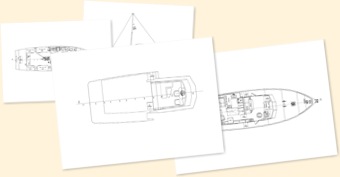
Drawings for MV Alpenglow

The layout for Alpenglow has subtly evolved since the original drawings were made. Some changes reflect thinking by the builder while other changes are at our request. Below are the current drawings.